
Bloomington Directory Runs by Year
Bloomington Public Library holds the broadest local run. Its city directories begin in 1855 and are almost complete through the present, though publishers and titles change. Many volumes are in the noncirculating Locked Case or on microfilm at the Adult Services Help Desk. The McLean County Museum of History and the library also placed the 1855 through 1920 run online. Later address-oriented Cole volumes, telephone books, rural directories, and county directories fill different gaps. Each source has its own geographic reach, so a Bloomington-Normal or county volume should not be read as if it covers only city limits.
| Collection | Years | Where Held | Access |
|---|---|---|---|
| Bloomington city directories | 1855 to present, almost complete | Bloomington Public Library | Locked Case, desk access, or microfilm |
| Digitized directories | 1855 to 1920 | McLean County Museum and Internet Archive | Free scans online |
| Cole Bloomington-Normal directory | 1982 to 1996/97 | Bloomington Public Library | In-library, criss-cross coverage |
| McLean County directories | Selected years, 1859/60 to 1959 | Bloomington Public Library | Local-history access |
| Bloomington telephone books | 1953; nearly continuous 1965 to current | Bloomington Public Library | In-library historical clue |
The exact last printed directory year was not stated in the official sources. Confirm a desired volume with the library before visiting. Missing years are not blank permission to guess. County books survive for selected dates including 1875/76, 1910, 1912, 1914, 1917, 1928, 1931, 1942, 1949, and 1959, while telephone and Cole runs become more useful in the later twentieth century.
Bloomington Library Directory Desk
The Bloomington Public Library Local History Collection is at 205 E Olive Street. Materials do not circulate. Ask the Adult Services Help Desk for Locked Case items, microfilm, or call number 917.732 BLO. Listed hours are Sunday 1 to 5 p.m., Monday through Thursday 9 a.m. to 9 p.m., and Friday and Saturday 9 a.m. to 5 p.m. Holiday hours may differ. Phone 309-828-6091 before a long trip.
The library's local-history gateway also points toward newspapers, maps, yearbooks, cemetery volumes, probate and will indexes, and subject files. In-building users can access Ancestry Library Edition, while HeritageQuest and Fold3 are listed among research tools. Access may differ away from the library.
The official gateway shows the current path to staff help and the Bloomington city directory shelf.
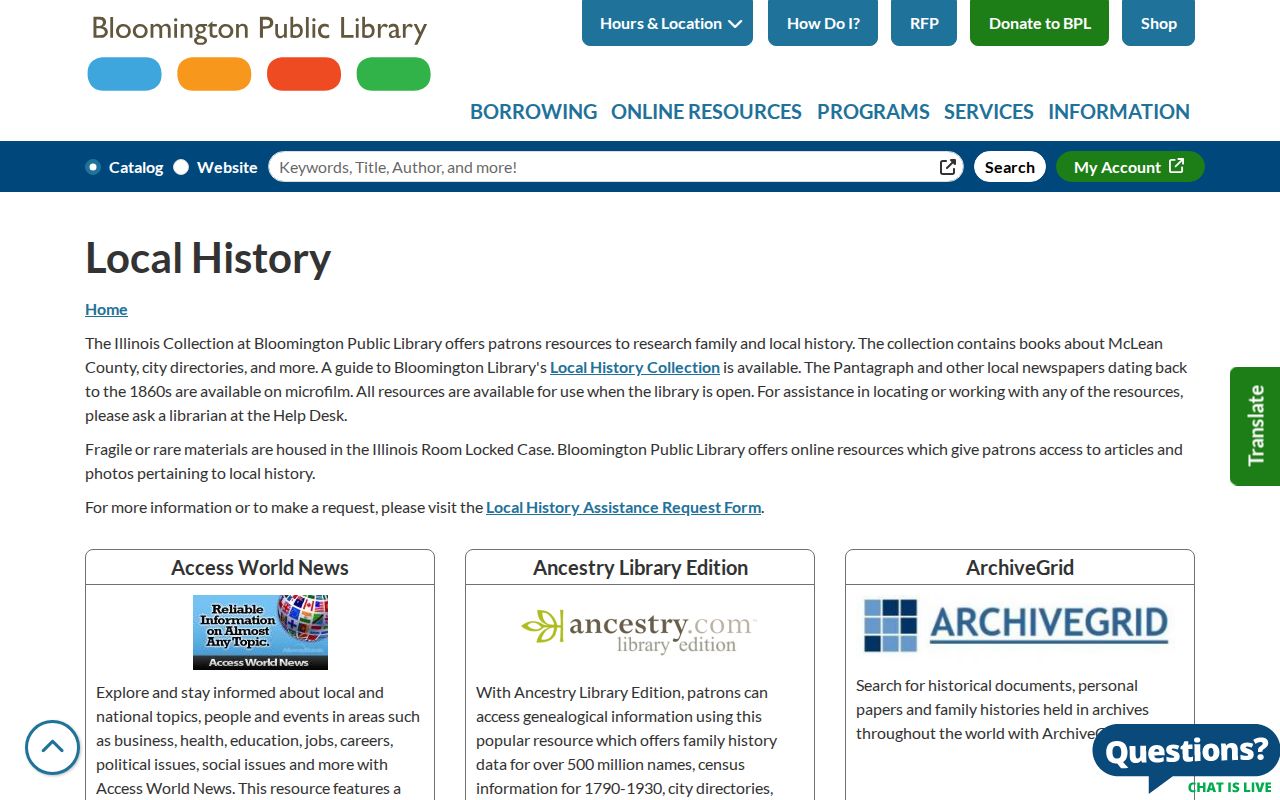
The captured page confirms a library route, not a commercial directory.
Bloomington Directories Online
The McLean County Museum directory project provides a year-by-year path to digitized Bloomington volumes from 1855 through 1920. Direct scans include 1855/56, 1859/60, 1870/71, 1880/81, 1893, 1902 with a map, 1911, and 1920. Start at the Museum list because it identifies the local project and the available years.
Internet Archive supplies page images and searchable text. Searchable text is fast, but the image is the evidence. Save the volume year and page, then inspect the abbreviation key and nearby entries. Optical character recognition, or OCR, can turn a short occupation, initial, or house number into the wrong text.
The Museum and library partnership is visible on the city-directory publication page.
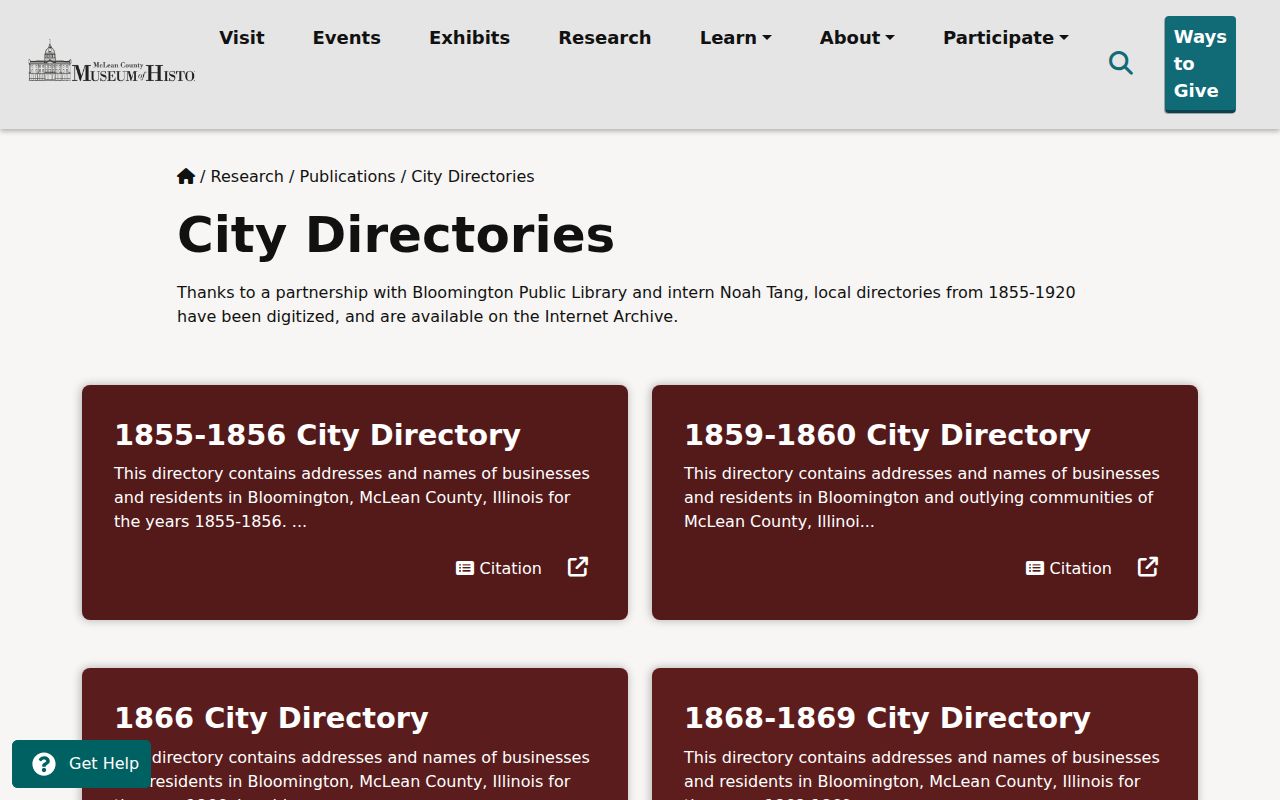
Use that page to choose a year before opening the scan.
The earliest digitized volume offers a useful test of names, trades, and street wording.
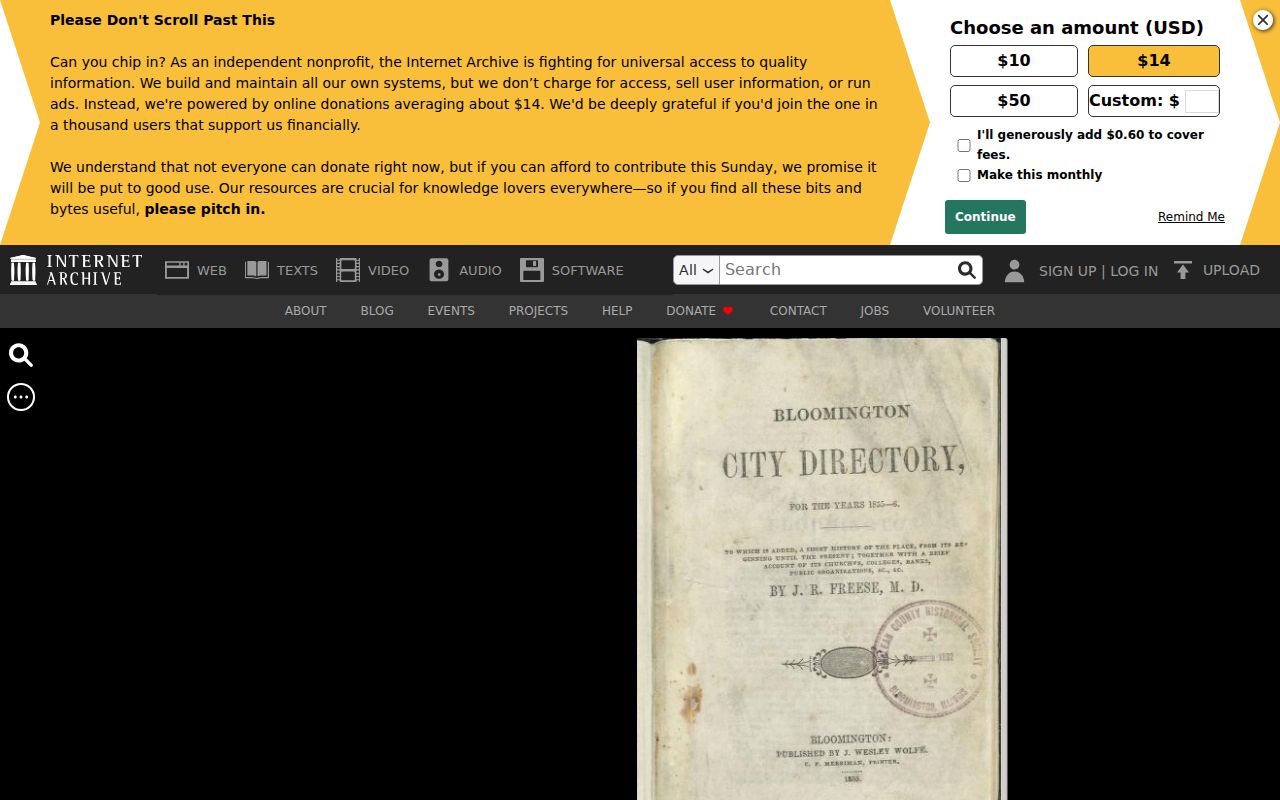
The scan anchors a citation to a dated publication, not a present-day claim.
Decode a Bloomington Directory Entry
A Bloomington city directory line can compress a household into a few words. The 1893 volume lists Charles Adams with a blacksmith connection and residence at 1017 W Taylor. Henry Adams, a fireman, appears at the same address. Eleanor Arnold appears as the widow of William at 709 E Taylor. Those lines support dated name, role, relationship notation, and address statements. They do not prove ownership, a complete household, or current occupancy.
| Indexed name | Surname and given name or initials as printed |
|---|---|
| Role or trade | Occupation or business relationship, often abbreviated |
| Residence | The mark res, followed by a directional street and house number |
| Household notation | Spouse, widow, or another relationship when included |
| Other sections | Street-number and classified-business entries that can cross-check the line |
- Criss-cross directory
- An address-first listing arranged by street and house number, useful when the resident's name is unknown.
- Householder index
- A name or address list of those selected by the publisher as household contacts, not a full census.
- Abbreviation key
- The volume's own list explaining shortened terms such as occupations, residence marks, and household notes.
Read the key for that exact year. Publisher practice can change. Shared addresses may describe relatives, lodgers, or a business and residence convention, so compare the resident section with the street and classified sections.
Bloomington Addresses Need Context
Bloomington uses Front Street as the north-south numbering base and Main Street as the east-west base. Directional prefixes carry real meaning, 101 begins a block side, and numbers generally rise by 100 per block. That system helps place an old directory line, but it does not guarantee that an old house number maps to today's parcel.
The Museum house-history guidance warns that streets can be renamed, numbers can change, houses can move, and printed directories can be wrong. Search the full directional form, then try spelling variants and neighboring years. For a modern address investigation, use the Bloomington street directory workflow rather than treating an old line as current.
Note: Preserve the printed prefix, house number, directory year, and scan page before translating an old Bloomington address to a modern map.
Beyond Bloomington City Directories
A disappearance from one run can mean a move, death, omission, name change, or print error. The library's microfilm and card index help test dates. Historical holdings include death notices from 1848 to 1870, obituaries from 1871 to 1880, probate material, church records, cemetery volumes, yearbooks, and local clippings. None should be forced to say more than its date and scope permit.
The Evergreen Memorial Cemetery grave search can return name, burial date, birth and death details, section, lot, residence, birthplace, marker, obituary, and notes. Burial is not residence, yet section and lot can separate people who share a name. The search does not state full coverage dates, so the cemetery office remains the fallback.
The Evergreen search presents this separate name-based route.
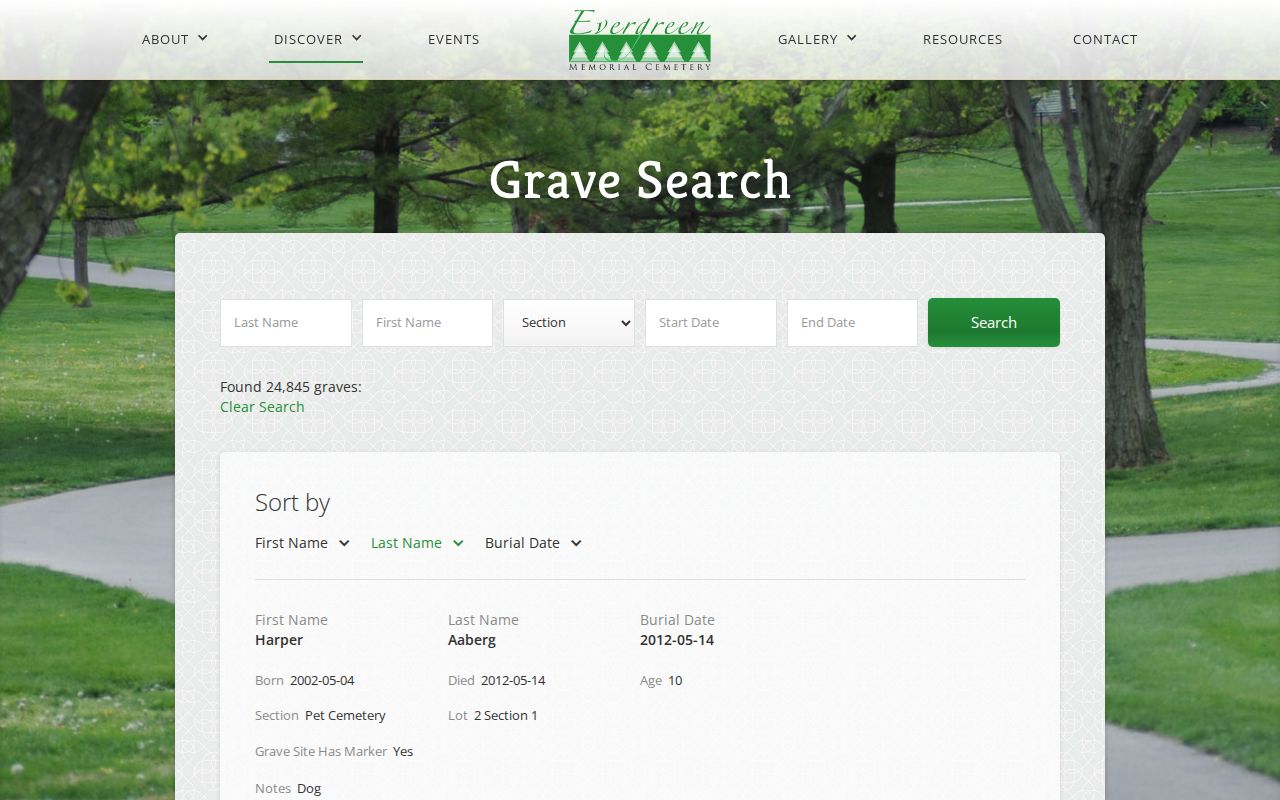
Pair its dated burial record with the correct directory volume and an obituary image.
Bloomington Records Survived Unevenly
Bloomington has been the McLean County seat since 1831, and city directories begin in 1855. A June 19, 1900 county fire damaged or destroyed some early records. That history makes a blank search result weak evidence. Directory volumes, newspapers, cemetery books, church registers, probate files, and Illinois Regional Archives Depository holdings may preserve a clue that a county series lost.
| Date | Bloomington record milestone |
|---|---|
| 1831 | Bloomington becomes the McLean County seat |
| 1853 | Chicago and Alton rail service begins a major local paper trail |
| 1855 | First year in the Bloomington city directory collection |
| 1900 | County fire causes documented record loss or damage |
| 1963 | City Township joins older cemeteries with Evergreen administration |
The 1900 fire is a search branch, not a reason to stop. Museum finding aids, library microfilm, and IRAD indexes become especially valuable for early names.
Trace Families in Bloomington Directories
Family research works best when each Bloomington city directory entry becomes one dated point, not a final answer. Begin near a known year. Move backward and forward, then add census, newspaper, cemetery, and probate sources only where their dates fit.
- Search the closest scan for the surname and likely variants. Inspect the page image, street index, and classified section.
- Check adjacent years. Record each address, role, spouse or widow notation, and first or last appearance.
- Use a criss-cross or street-number section to test the address. Do not assume every resident was printed.
- Pair the directory years with the closest census schedule. The library lists McLean census material through 1930, with no 1890 federal census.
- Use a newspaper, obituary, cemetery, yearbook, probate, or will index to explain a move or disappearance.
The library's collection page shows the current access route.
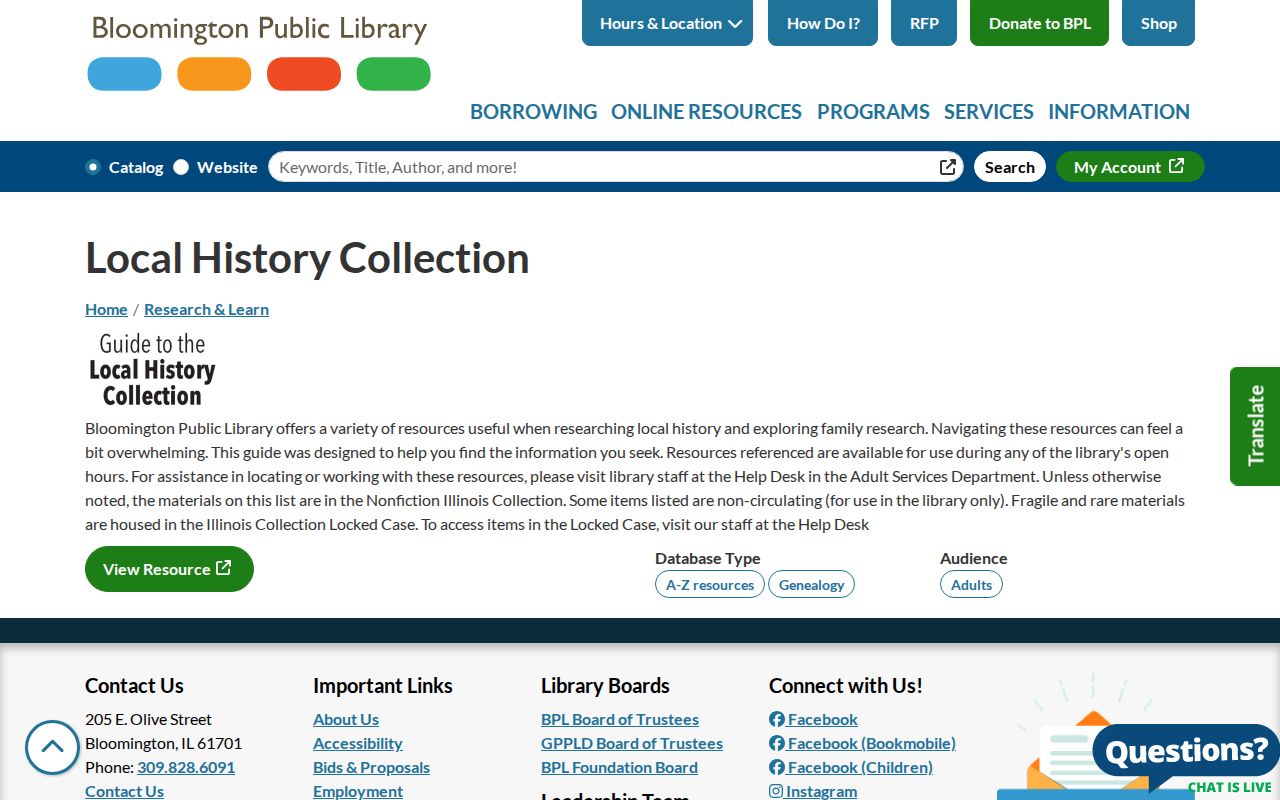
The collection page is the best source for desk access and holdings before a visit.
A missing listing never proves death or departure by itself. Search variant spellings, initials, nearby years, and address sections. Then cite the exact volume and page that supports the conclusion.
Bloomington Directory Shelf Companions
The main name list is only one part of Bloomington's local shelf. The Cole Directory for Bloomington-Normal and nearby communities covers 1982 through 1996/97 and can be approached by address in its criss-cross portions. McLean County directories reach rural areas in selected years. Farm and Home Plat and Directory volumes from 1992 and 1994 forward include occupant and phone indexes, plat-owner indexes, and a business section. Rural Directory examples survive for 1973, 1975, 1978, 1982, and 1985. These are separate publications with different coverage, not missing volumes from one continuous city series.
Telephone books form another run. Bloomington has a 1953 volume and an almost continuous series from 1965 onward. Greater Bloomington-Normal books cover 1985/86 through 1993/94, while county examples include 1966 and 1978 through 1984. A telephone listing establishes what one publisher printed at one date. It may omit an unlisted number, use one household contact, or retain an old address. Check the title page and date before linking it to a city-directory entry.
Business and railway directories reach further back. The library lists C. Chandler & Co. for 1868, Illinois State Gazetteer volumes for 1858/59 and 1864/65, and a Lakeside Directory for 1875. They can explain a trade or firm named in a resident line. The Chicago and Alton Railroad collection adds contracts, letters, timetables, union material, and community organization records after rail service arrived in 1853. It supplies context, not current person data.
Search Bloomington Directory Scans
Begin with the Museum's year list, then open the nearest scan. Search the OCR for the surname and likely variants, but also search a street, firm, spouse name, or occupation. When a hit appears, move to the page image. Read several entries above and below it because headings and column breaks often explain the wording. Photograph or note the title page, abbreviation key, page number, and full entry. A copied OCR line without its image loses the evidence needed to fix a bad character.
The 1893 directory shows why this method works. Its resident list, Street Number Directory, and classified business directory offer three views of the same city. A Taylor Street line can be tested in street order and then against a firm or trade. The OCR describes Taylor's position in the older grid, but the Museum cautions that old numbers and names may change. Modern parcel research should begin again with a current address and PIN.
When two people share a name, build a small dated ledger. Record year, printed name, address, role, household notation, and scan page. Add a newspaper or cemetery fact only if the date and identity align. This method prevents a plausible story from outrunning the sources.